
Biophilia: Beyond the Planter Box — The New Science of a Home That Breathes


I. The Quiet Revolution: A New Definition of Sanctuary
The first thing you notice is the quiet. Not the sterile silence of an insulated room, but a living quietude that feels both profound and elemental. Step across the threshold from the clamour of a city like Mumbai or Delhi—a world of chronic sensory overload, where the nervous system is kept in a constant state of hyper-arousal —and the air itself seems to change. It feels cooler, cleaner, somehow softer. The relentless urban soundscape of horns and construction fades, replaced by the subtle rustle of leaves or the gentle murmur of moving water. This is the palpable sensation of entering a biophilic home, a space designed not merely for shelter, but for restoration.
The discourse on modern living has shifted. Where once luxury was measured in carats and square feet, today it is quantified by tranquility and a connection to the natural world. This is not a fleeting trend for 2025 but a deep, resonant recalibration of what it means to live well, particularly in the context of urban India. The relentless pace of city life, with its documented links to higher rates of anxiety, depression, and respiratory illness, has created a collective yearning for respite. The post-pandemic consciousness has only amplified this need, transforming outdoor lounges, courtyards, and home gardens from luxuries into essentials.
This societal craving for sanctuary converges perfectly with a parallel evolution in the luxury market itself. The very concept of luxury is undergoing a significant transformation, pivoting away from conspicuous opulence towards a more nuanced understanding that prioritizes "personalization, sustainability, and meaningful consumption". Younger, more conscious consumers are seeking experiences that enrich their lives and resonate with their identities, a philosophy best described as "health-as-wealth". They are drawn to value that transcends monetary cost, seeking fulfillment over mere possessions.
In this new paradigm, biophilic design emerges as the definitive answer. It is far more than an aesthetic choice; it is a cultural corrective, a scientifically validated response to the pressures of our built environment. It represents a society actively seeking an antidote to its self-imposed environmental and psychological stressors. The home is reimagined as a restorative ecosystem, and the ultimate luxury good is no longer a rare material or an imported brand, but a scientifically-proven sense of peace. The design is not just a product; it is a prescription for a better life.
II. The Innate Connection: The Science of a Soulful Space
To understand why these spaces feel so profoundly right, one must look beyond design trends and into the core of human biology. The philosophy is grounded in a concept known as the "Biophilia hypothesis," famously articulated by American biologist Edward O. Wilson. He defined biophilia as the "innately emotional affiliation of human beings to other living organisms". This is not a romantic notion but a hardwired, evolutionary need. For millennia, our survival depended on a deep, symbiotic connection with nature; it is a need rooted in our genetic heritage. The modern urban environment, which isolates us from the natural world, runs counter to our intrinsic biological programming, adversely impacting our mental and physical health.
Biophilic design is the deliberate attempt to translate this innate connection into the built environment. Its remarkable efficacy is not anecdotal; it is supported by robust theories from environmental psychology that explain how these spaces heal, restore, and inspire.
Three foundational theories underpin its power. The first is Stress Recovery Theory (SRT), which posits that even brief, passive exposure to natural elements—a view of a tree, the sound of water—can trigger a positive psychophysiological response, measurably reducing stress, lowering blood pressure, and calming the heart rate. The second is
Attention Restoration Theory (ART). Urban life relentlessly taxes our "directed attention," leading to mental fatigue. Natural environments, with their gentle complexities, engage our "involuntary attention" effortlessly, allowing our cognitive resources to rest and recover. The third is
Prospect-Refuge Theory, which explains our evolutionary preference for environments that offer both broad, open views ('prospect') for surveillance and safe, enclosed areas ('refuge') for protection. This is why a window seat overlooking a garden or a cozy reading nook feels so instinctively comforting and secure.
Pioneering thinkers like the late Stephen R. Kellert structured these concepts into a practical framework for designers, categorizing our experience of nature into three types: Direct Experience (actual light, plants, water), Indirect Experience (natural materials, biomorphic forms), and the Experience of Space and Place (prospect, refuge, mystery). This framework was further articulated into a comprehensive toolkit: the 14 Patterns of Biophilic Design, which provide a blueprint for creating spaces that actively support human well-being.
The 14 Patterns of Biophilic Design: A Blueprint for Well-being | |
Category | Pattern & Description |
Nature in the Space (Direct, physical presence of nature) | 1. Visual Connection with Nature: A view to elements of nature, living systems, and natural processes. 2. Non-Visual Connection with Nature: Auditory, haptic, olfactory, or gustatory stimuli that reference nature. 3. Non-Rhythmic Sensory Stimuli: Brief, unpredictable connections with nature, like the sway of grass or flicker of a flame. 4. Thermal & Airflow Variability: Subtle changes in air temperature, humidity, and flow that mimic natural environments. 5. Presence of Water: Enhancing an experience through seeing, hearing, or touching water. 6. Dynamic & Diffuse Light: Varying intensities of light and shadow that change over time, as found in nature. 7. Connection with Natural Systems: An awareness of natural processes, like seasonal changes or the cycles of life. |
Natural Analogues (Organic, non-living, and indirect evocations of nature) | 8. Biomorphic Forms & Patterns: Symbolic references to contours, textures, and patterns that exist in nature. 9. Material Connection with Nature: Using minimally processed natural materials that reflect the local ecology or geology. 10. Complexity & Order: Rich sensory information adhering to a spatial hierarchy similar to that found in nature. |
Nature of the Space (Spatial configurations that mimic preferred natural environments) | 11. Prospect: An unimpeded view over a distance, for surveillance and planning. 12. Refuge: A place for withdrawal, protected from behind and overhead. 13. Mystery: The promise of more information, achieved through partially obscured views that entice exploration. 14. Risk/Peril: An identifiable threat coupled with a reliable safeguard, creating a sense of thrill and excitement. |
III. Case Study I: A Sanctuary in Surat — The 'Jungalow' Residence

Nowhere is the power of biophilic design more evident than when it moves from theory to lived reality. On the fringes of Surat, Gujarat, stands a home that serves as a powerful manifesto for this philosophy. Designed by the firm Neogenesis+Studi0261, the "Jungalow" was conceived for a unique client: an agriculturist and his family who wished to "inhabit an urban location while remaining in touch with nature". This brief, a perfect encapsulation of the modern urban paradox, demanded a solution that went far beyond mere decoration. The result is a home where nature is not an addition, but the fundamental organizing principle.
The heart of the structure is a breathtaking double-height courtyard, a living, breathing lung that connects every level of the home. Embellished with a profusion of creepers and climbing plants, it forms a lush "green curtain" that serves multiple functions. It provides a constant
Visual Connection with Nature (Pattern 1) from almost every room. This is not a static view but a dynamic ecosystem that changes with the light and seasons, a clear application of Connection with Natural Systems (Pattern 7). The green curtain also acts as a brilliant passive design element, filtering the harsh western sun and creating a thermal buffer, demonstrating Thermal & Airflow Variability (Pattern 4). Operable glass walls flanking the courtyard retract completely, dissolving the boundary between inside and out and allowing the living spaces to merge with this verdant core.
The sensory experience is multi-layered. Dappled sunlight filters through a large circular aperture in the roof, creating shifting patterns on the walls and floors below—a beautiful example of Dynamic & Diffuse Light (Pattern 6). The home breathes. A triple-height void housing a shrine based on the form of a
Shikhara (a Hindu temple spire) acts as a wind tunnel, pulling air through the structure and ensuring natural ventilation. The dense foliage also serves as an acoustic buffer, dampening the city's noise and replacing it with the gentle sounds of nature—a powerful
Non-Visual Connection with Nature (Pattern 2).
The materiality is honest and direct. Basic building materials are left in their natural state, their raw textures complementing the flora—a clear application of Material Connection with Nature (Pattern 9). Biomorphic forms appear in details like the large circular windows, which serve as "natural picture frames," curating views of the landscape outside
(Pattern 8).
The Jungalow is the perfect antithesis to the superficial "planter box" approach. Here, the architecture is fundamentally structured around living systems. It is a radical integration that proves true biophilic design is not an interior decorating choice, but a profound architectural strategy. It is a home designed to be a "comfortable natural environment," a direct and deeply felt solution to "modern-day exhaustion and stress".
IV. Case Study II: Ahmedabad's Urban Oasis — A Study in Serene Modernism

If the Jungalow demonstrates biophilia's capacity for lush and immersive wildness, a modern bungalow in Ahmedabad by Studio.609 showcases its elegant subtlety. This project proves that biophilic principles are not tied to a single aesthetic but can be seamlessly integrated into a sleek, contemporary, and minimalist framework. The brief from the family of four was for a "harmonious blend of contemporary elegance and natural serenity," a home that would serve as a "sanctuary from the bustling city life". The resulting design, described as "Scandinavian-inspired... infused with bohemian warmth," is a masterclass in quiet restoration.
The design's primary achievement is its mastery of light and space. The architects proposed an open layout that "maximizes natural light and ventilation". Large windows framed by sheer curtains flood the interiors with soft, diffuse light, a textbook execution of
Dynamic & Diffuse Light (Pattern 6) and providing a constant Visual Connection with Nature (Pattern 1). The open-plan living area creates long, uninterrupted sightlines through the home, fostering a sense of freedom and control that is a hallmark of Prospect (Pattern 11).
Within this open framework, the design skillfully carves out areas of sanctuary. The living area, with its plush beige sectional sofa, and the master bedroom, conceived as a "tranquil retreat," are perfect examples of Refuge (Pattern 12). They offer spaces for both family gathering (prospect) and quiet withdrawal (refuge), achieving the critical psychological balance that makes a home feel both expansive and secure.
The connection to nature is also expressed through a sophisticated palette of natural analogues. The home is layered with warm wood tones, an earthy color palette of soft greys, beiges, and terracotta, and locally sourced, sustainable materials, creating a rich Material Connection with Nature (Pattern 9). Representations of nature appear in a striking tree mural that ascends with the staircase and a whimsical floral mural in the daughter's bedroom, both examples of Biomorphic Forms & Patterns (Pattern 8). The tactile richness of striped rugs and layered textiles provides a subtle Complexity & Order (Pattern 10), engaging the senses without overwhelming them.
This Ahmedabad residence is a testament to biophilic design's versatility. It demonstrates how the principles can be woven into a modern aesthetic to create a home that is both a sophisticated piece of contemporary design and a deeply restorative environment. It is a space that perfectly "reflects the family's values—comfort, togetherness, and an appreciation for nature".
V. The Architect's Perspective & The Psychologist's Proof
The success of these homes lies in a powerful convergence of disciplines. What the architect intuits, the psychologist can prove. The spaces feel right because, on a neurological and physiological level, they are right.
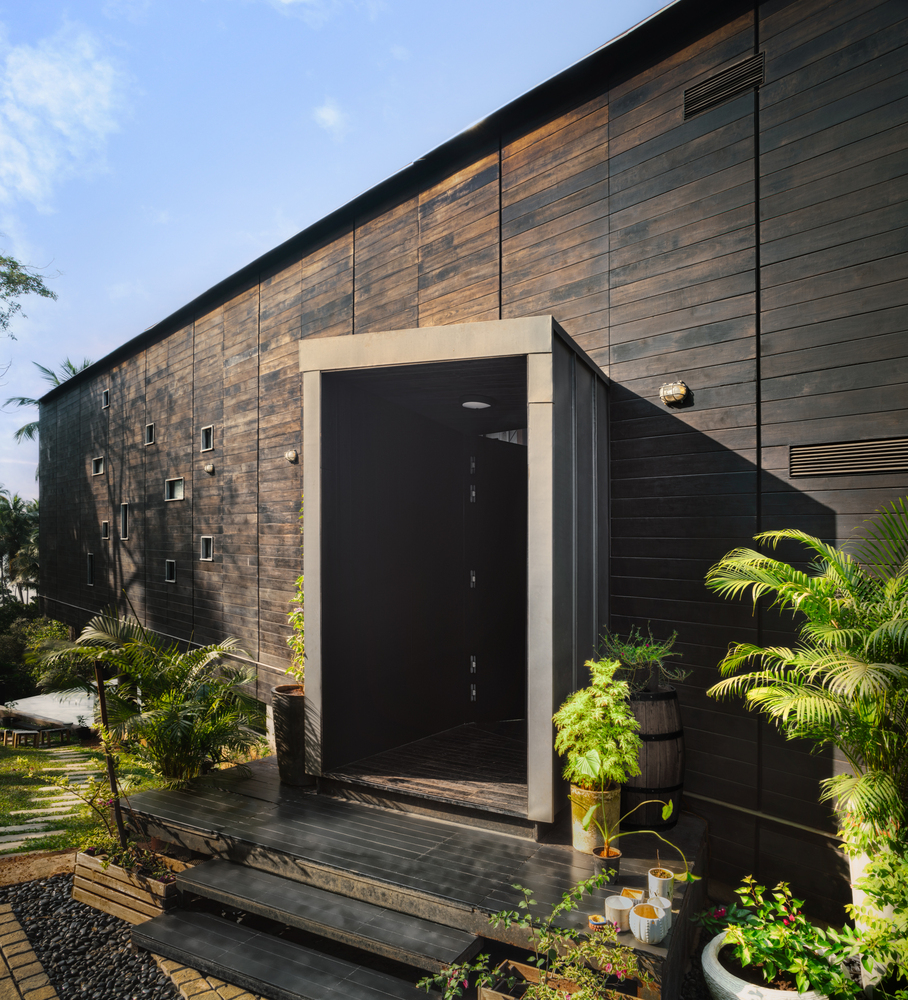
Indian architects at the forefront of this movement articulate a philosophy that goes far beyond aesthetics. Gauri Satam and Tejesh Patil of unTAG, designers of the stunning Villa Prakriti in the Western Ghats, describe their approach as aspiring to "live in nature's likeness—adaptive, rooted, generous, and ever-evolving." For them, natural elements like green inserts, light, and earthen textures are "not aesthetic decisions, but fundamental design elements that guide form, flow, and feeling". This ethos, which prioritizes the sensory and emotional experience of a space, is echoed by architect Nilanjan Bhowal, who emphasizes that architecture must "engage all five senses, creating spaces you don't just see—but feel".
This design intent is validated by the field of environmental psychology. Anju Sara Abraham, who holds degrees in both architecture and environmental psychology, notes that her training has taught her to think of a space as "a platform for human behaviour and how minuscule changes in the design can alter one's behaviour and mood". This provides the crucial scientific link between a design choice—like the orientation of a window or the texture of a wall—and its psychological outcome.
Recent empirical studies confirm this link unequivocally. A 2025 study demonstrated that exposure to biophilic design has a direct, positive effect on psychological states. Participants in the study reported feeling more relaxed, less fatigued, safer, and more inspired when viewing interiors with high biophilic quality, while spaces devoid of these features tended to have an adverse effect. This research provides the hard evidence that underpins the entire premise of biophilic design: it is a data-driven strategy for well-being. This convergence of architecture, psychology, and even ancient wellness traditions like Vastu Shastra, which has long focused on aligning spaces with natural energies , is what makes the field so powerful. It is not one discipline's trend, but a multi-disciplinary consensus on how to live better.
VI. Beyond Aesthetics: An Investment in Living Well
We have arrived at a new understanding of home. In the face of mounting urban pressures and a collective reassessment of our priorities, our homes must become more than mere shelters; they must be active participants in our well-being. They must be our sanctuaries. Biophilic design is the most intelligent, elegant, and scientifically sound path to achieving this.
The creation of these tranquil, rejuvenating spaces is therefore not an expense, but a profound investment. As the value proposition of luxury shifts from material wealth to holistic well-being, the conversation with a client changes. They are not just purchasing an aesthetic; they are making a long-term investment in their mental and physical health. This is a deeper, more compelling, and ultimately more valuable proposition than any offered by traditional luxury.
The biophilic home is not a static object but a living, breathing partner in a well-lived life. It is a place that nurtures, restores, and constantly reconnects us to the natural world of which we are intrinsically a part. It is a home that breathes with us. This is the future of intelligent, humane, and truly luxurious living—a future that is already taking root, beautifully and restoratively, in the heart of modern India.

Comments